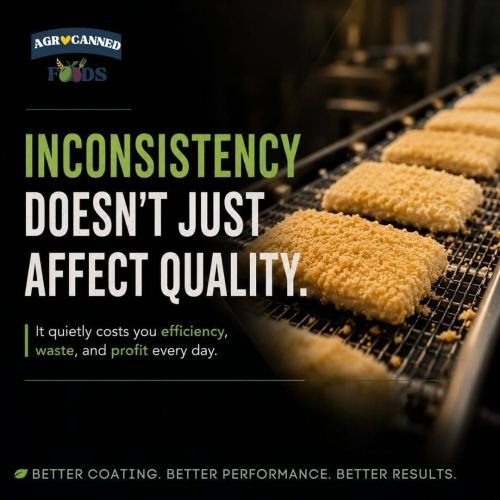
In industrial seafood processing, coating adhesion failure — commonly referred to as delamination — is one of the most costly post-frying defects in breaded fish fillet production.
For export-oriented seafood manufacturers, coating separation is not just a cosmetic issue. It directly affects:
Product yield
Customer complaints & rejection rates
Freezing stability
Brand reputation in international markets
This article explains the root causes of coating delamination after frying, specifically in high-volume seafood processing environments.
Coating delamination occurs when the breading layer (predust, batter, breadcrumbs, or panko) separates partially or completely from the fish fillet after frying.
It may appear as:
Coating peeling off in sheets
Air gaps between coating and muscle
Excessive coating fall-off during freezing or packaging
Cracking after blast freezing
Fish fillets naturally contain high surface moisture.
If not properly controlled before predusting:
Excess water prevents proper adhesion
Steam forms during frying
Pressure builds between coating and muscle
Result: The coating lifts and separates.
Critical for exporters:
Moisture imbalance becomes worse after IQF freezing and long-distance shipping.
Predust acts as the primary binding layer between fish protein and batter.
Common mistakes in seafood plants:
Uneven coverage
Wrong particle size
Low pickup rate
Skipping predust stage entirely
Without proper protein-to-starch interaction, the coating cannot anchor to the fillet surface.
Batter viscosity directly influences coating adhesion.
If batter is:
Too thin → weak film formation
Too thick → traps excess moisture
Optimal viscosity ensures:
Proper encapsulation
Even crumb attachment
Reduced steam pocket formation during frying
For industrial lines, viscosity should be monitored per shift, not per day.
Delamination is often a thermal issue.
Key variables:
Oil temperature
Dwell time
Oil turnover rate
If surface sets too fast → internal moisture escapes aggressively → steam lifts coating.
If temperature is too low → coating absorbs oil and weakens structurally.
For export-grade breaded seafood, thermal profiling is essential.
Not all breadcrumbs behave the same.
Industrial seafood processors must consider:
Particle size distribution
Bulk density
Oil absorption rate
Expansion characteristics
Light, airy panko behaves differently from dense breadcrumbs.
Mismatch between batter and crumb structure increases risk of separation.
Different fish species behave differently.
Factors affecting adhesion:
Fat content
Protein composition
Fillet thickness
Surface smoothness
Example:
High-fat fish release more oil during frying
Very smooth fillets provide weak mechanical grip
R&D teams should validate coating systems per species (pollock ≠ tilapia ≠ hake).
Many exporters notice delamination only after freezing.
Blast freezing causes:
Rapid internal contraction
Stress between muscle and coating
Micro-fractures
If coating bond is already weak, freezing amplifies the defect.
International buyers evaluate:
Coating integrity after reheating
Crumb retention after baking
Visual appearance after thawing
Delamination increases:
Rejection rates
Retail complaints
Cost per ton
Loss of long-term contracts
For high-volume exporters, even a 2% defect rate significantly impacts profitability.
For seafood manufacturers targeting export markets:
Use air knives or controlled dewatering.
Choose particle size suitable for fish texture.
Measure and log per production batch.
Panko ≠ Standard Breadcrumbs. Validate through pilot trials.
Surface set must synchronize with internal moisture migration.
Conduct post-IQF adhesion tests before shipment.
Fish fillet coating delamination is not caused by one single factor.
It is the result of:
Moisture + Adhesion System + Thermal Profile + Freezing Stress
Export-focused seafood manufacturers must treat coating systems as an integrated process — not just an ingredient choice.
Seafood Processing Challenges
tempura-vs-clear-coat-shrimp 2026-02-26Seafood Processing Challenges
coating-delamination-in-fish-fillets 2026-02-23poultry-coating-systems
Breadcrumb Blow-Off in Poultry Products 2026-01-13Tempura vs Clear Coat Batter: Which System Stabilizes Your Shrimp Line? Executive Perspective In...
Read MoreCoating Delamination in Fish Fillets: Root Causes & Practical Fixes Coating delamination in fish...
Read MoreTempura Batter vs Clear Coat Batter for Shrimp Lines: A Practical Selection Guide Shrimp coating...
Read More