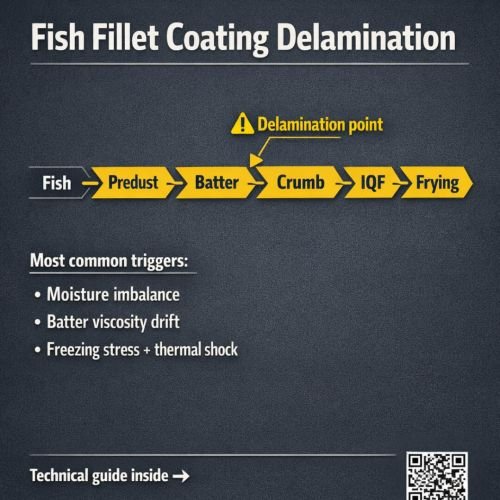
Coating delamination in fish fillets is one of the most frustrating failures on seafood lines.
The product may look perfectly coated before freezing — then the coating separates after IQF, during transfer, or at the fryer.
This issue rarely comes from one ingredient alone.
In most cases, it is a process-ingredient mismatch that creates weak bonding points early in the line.
Delamination is typically seen as:
Batter separating from the fillet surface
Crumb layer peeling off in sheets
Cracks forming at the batter/crumb interface
Coating detaching during frying or after freezing
Even when it appears “at frying,” the failure often begins before IQF.
Fish behaves differently because it has:
Higher surface moisture variability
A softer muscle structure with less mechanical anchoring
A smoother surface that reduces bonding
Higher sensitivity to freezing stress
That makes adhesion systems on fish lines less forgiving than poultry systems.
If fillets enter coating too wet:
Predust clumps or dissolves
Batter becomes diluted at the surface
Adhesion becomes unstable
Fix: Control drain time and surface wetness before predust/batter. Consistency matters more than absolute dryness.
Predust is often treated as optional, but on fish it is frequently critical.
Wrong predust behavior can cause:
weak anchoring
uneven batter pickup
unstable bonding during freezing
Fix: Use predust to “condition” the surface — not just as a powder layer. Align it with moisture level and fillet texture.
Many lines control batter at startup, then viscosity changes during production.
When viscosity drifts:
coverage becomes uneven
bonding points weaken
delamination appears after IQF or frying
Fix: Monitor viscosity and solids as a production parameter, not only as an R&D parameter. Stability across shifts is the real tes
Cause 4: Weak batter-crumb interface (particle mismatch)
Delamination commonly occurs between batter and crumb.
This can happen when:
crumb size is too coarse for the batter film
batter film is too thin to anchor particles
line speed reduces contact time
Fix: Match crumb structure and particle size to batter pickup and target texture. The interface must be engineered as a system.
Freezing creates micro-stress in coating layers.
If adhesion is weak, freezing becomes the trigger.
Frying then amplifies failure through thermal shock.
Fix: Evaluate performance across the full cycle: coating → IQF → storage → frying. A system that “looks fine” before IQF may not be stable.
If delamination occurs, check the following in order:
Surface wetness consistency before predust
Predust behavior (clumping, dissolution, uneven pickup)
Batter viscosity stability across shifts
Crumb size vs batter film thickness
IQF conditions and time-to-freeze
Frying temperature stability
Coating delamination on fish fillets is rarely solved by switching one ingredient.
It is solved by aligning:
moisture control
predust function
batter stability
crumb structure
and freezing/frying conditions
When these variables work together, coating stability becomes repeatable — even at scale.

Seafood Processing Challenges
IQF Freezing Stress and Its Impact on Fish Coating Adhesion 2026-08-05
Seafood Processing Challenges
How Batter Viscosity Drift Breaks Fish Coatings | Improve Coating Performance 2026-08-05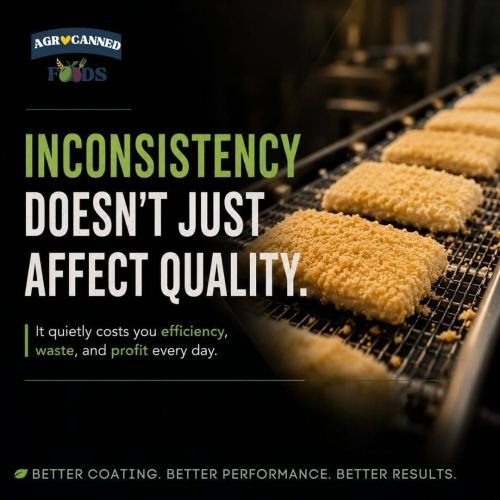
Company News
The Hidden Cost of Inconsistent Coating Pickup 2026-07-06
IQF Freezing Stress and Its Impact on Fish Coating Adhesion Why IQF Freezing Can Affect Coating...
Read More
How Batter Viscosity Drift Breaks Fish Coatings Why Consistent Batter Viscosity Matters in...
Read More
How Frozen Storage Affects Breaded Fish Quality For many seafood manufacturers, frozen storage is...
Read More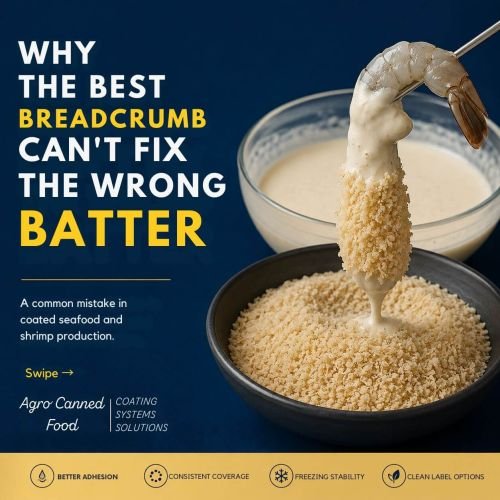
Why the Best Breadcrumb Can't Fix the Wrong Batter A seafood processor changes breadcrumb...
Read More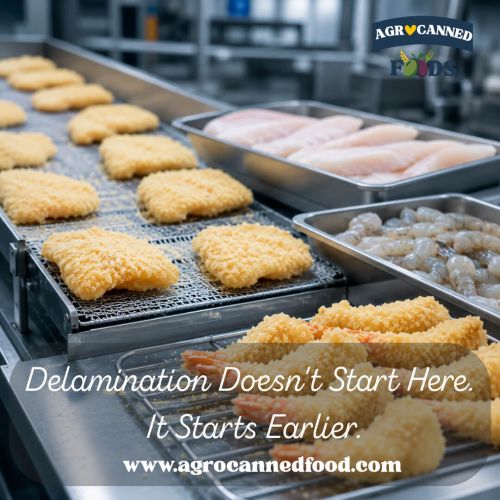
Delamination Is Not a Fryer Issue — Why Seafood Coating Failures Often Start at Predust...
Read More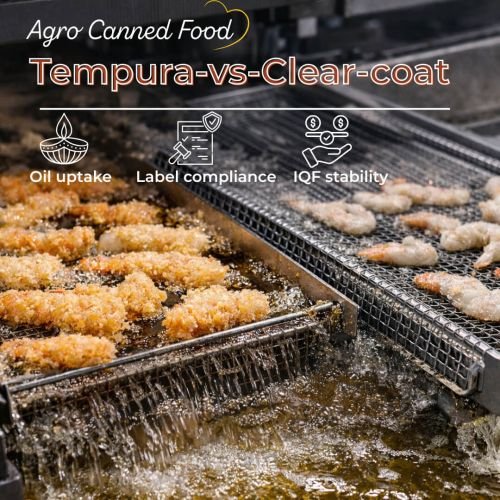
Tempura vs Clear Coat Batter: Which System Stabilizes Your Shrimp Line? Executive Perspective In...
Read More
Trusted manufacturer and exporter of premium food ingredients and preserved specialties. Experts in Coating Solutions, Preserved Products, and Olive Oil – delivering consistency and quality to food industry professionals worldwide.
 English
 العربية
 Spanish
 Germain