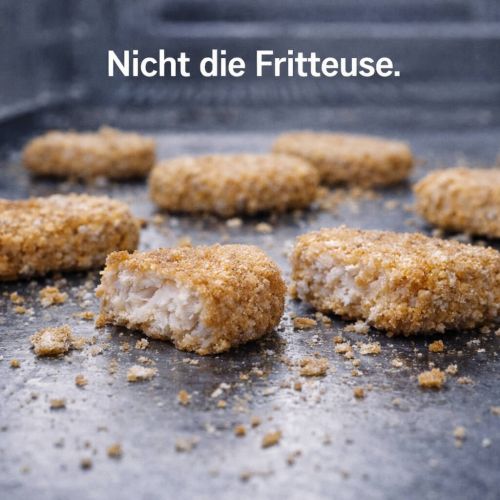
Oil temperature is adjusted.
Frying time is modified.
Filtration cycles are increased.
Yet coating instability persists.
Because most poultry coating failures are not fryer issues.
They are system imbalances revealed under thermal stress.
In industrial nugget, tender, and fillet lines, coating loss of 2–6% can result in:
15–40 kg yield reduction per ton
8–15% increase in oil contamination load
±1–2% deviation in declared coating ratio
Retail specification non-conformance risk
The fryer exposes failure.
It rarely causes it.
The fryer is the first stage where coating instability becomes visible.
Symptoms include:
Surface lifting
Crumb shedding
Patchy coverage
Excess crumb accumulation in oil
However, visible failure does not equal root cause.
Excess moisture converts to steam under heat.
Steam pressure lifts coating before structural setting.
👉 Related reading: Breadcrumb Blow-Off in Poultry Products: The Real Causes Behind Coating Loss.
Predust forms the adhesion bridge between poultry protein and batter.
Weak bonding increases detachment under mechanical or thermal load.
Mismatch between viscosity and crumb structure leads to:
Poor embedding
Trapped moisture
Structural instability
Raising oil temperature to “fix” blow-off often:
Accelerates surface sealing
Increases oil absorption
Darkens product appearance
Temperature adjustment may mask the symptom without solving the upstream cause.
| Variable | Fryer Adjustment Effect | Root Cause Correction Effect |
|---|---|---|
| Oil Temperature | Temporary visual improvement | Structural stability |
| Dwell Time | Color change | Adhesion integrity |
| Filtration | Cleaner oil | Reduced crumb shedding |
| Moisture Control | — | Steam pressure reduction |
| Predust Optimization | — | Bond strength increase |
System correction outperforms parameter tweaking.
For EU and export-oriented poultry processors:
Coating percentage must remain within tolerance
Fat declaration must be consistent
Surface uniformity affects acceptance
Repeated fryer adjustments without upstream correction increase:
Audit deviation probability
Oil degradation cost
Energy consumption
Not in most cases. Frying parameters expose existing weaknesses rather than create them.
Temporarily, yes. However, this may increase oil absorption and does not correct adhesion or moisture imbalance.
Because differential contraction during IQF reveals weak bonding created earlier in the process.
In stable industrial poultry systems, coating loss typically remains below 2–3%. Above 4–5% indicates structural imbalance.
Only after upstream variables — moisture, predust, batter compatibility — have been evaluated.
The fryer is a stress amplifier.
It reveals system instability that originated upstream.
Corrective action must extend beyond temperature adjustment and address:
Moisture management
Adhesion architecture
Layer compatibility
Thermal profiling
Mechanical load
Freezing validation
Coating stability is a system outcome — not a fryer setting.

Seafood Processing Challenges
IQF Freezing Stress and Its Impact on Fish Coating Adhesion 2026-08-05
Seafood Processing Challenges
How Batter Viscosity Drift Breaks Fish Coatings | Improve Coating Performance 2026-08-05
Company News
The Hidden Cost of Inconsistent Coating Pickup 2026-07-06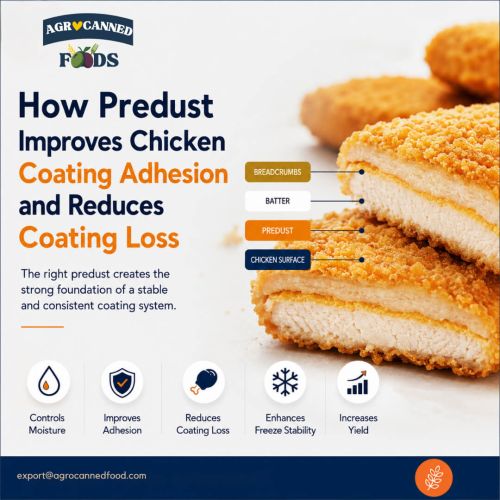
How Predust Improves Chicken Coating Adhesion and Reduces Coating Loss Strong coating adhesion is...
Read More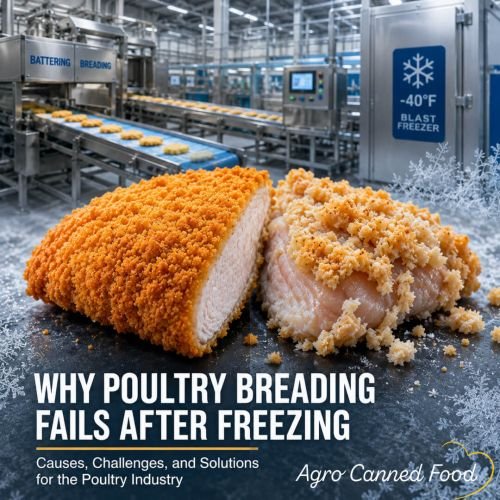
Why Poultry Coatings Fail After Freezing Understanding the Hidden Cost of Coating Failure In the...
Read More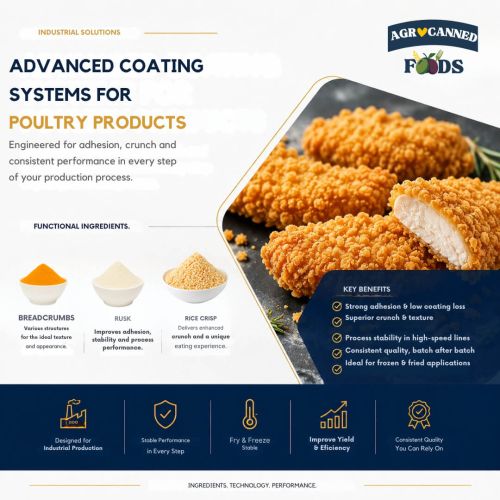
For poultry processors, achieving a crispy coating is only part of the challenge. Many...
Read More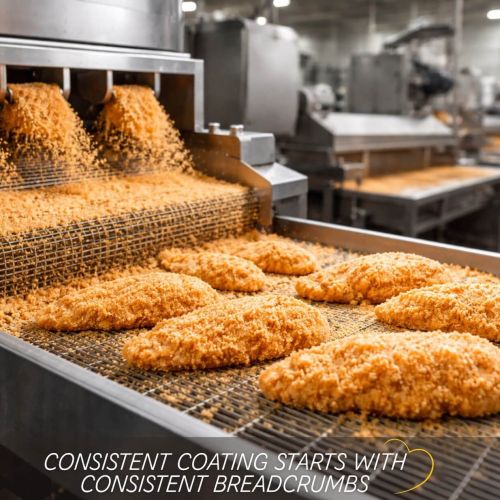
Color Consistency in Poultry Coatings Explained: The Critical Role of Breadcrumb Performance...
Read More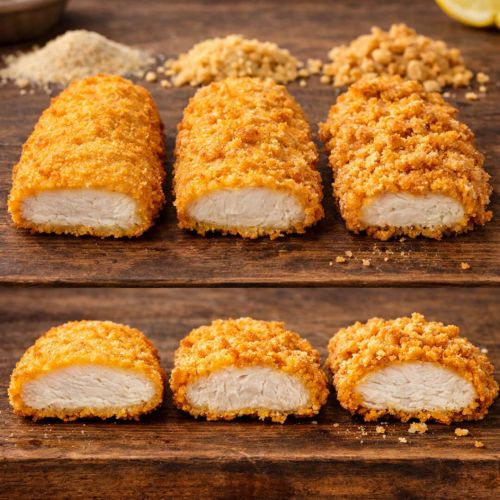
How Breadcrumb Particle Size Changes Chicken Texture In breaded chicken products, texture is...
Read More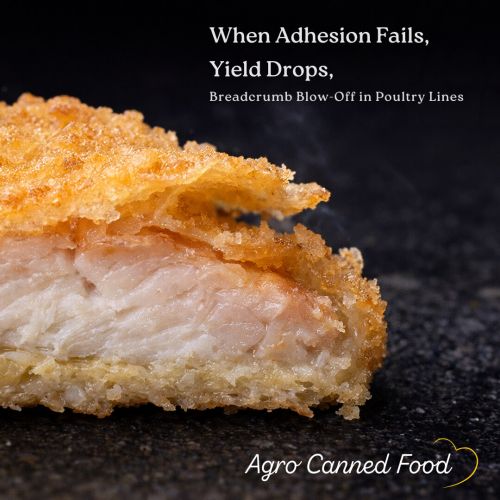
Breadcrumb Blow-Off in Poultry Products: The Real Causes Behind Coating Loss Breadcrumb blow-off...
Read More
Trusted manufacturer and exporter of premium food ingredients and preserved specialties. Experts in Coating Solutions, Preserved Products, and Olive Oil – delivering consistency and quality to food industry professionals worldwide.
 English
 العربية
 Spanish
 Germain