
Individually Quick Frozen (IQF) technology has become the preferred freezing method for seafood manufacturers thanks to its ability to preserve freshness, extend shelf life, and maintain product quality. From breaded fish fillets and shrimp to seafood portions and ready-to-cook products, IQF processing plays a critical role in modern food manufacturing.
However, while IQF freezing protects the product, it also places significant stress on the coating system.
Many manufacturers notice that products leaving the coating line look perfect, yet after freezing and storage, the coating begins to crack, separate, or lose adhesion. These issues often appear during packaging, transportation, or final preparation, increasing waste and reducing customer satisfaction.
Understanding how IQF freezing affects fish coating adhesion is essential for building a coating system capable of maintaining consistent performance from production to the consumer's plate.
IQF (Individually Quick Frozen) rapidly freezes each product separately by exposing it to extremely low temperatures.
Unlike conventional freezing, IQF minimizes the formation of large ice crystals, helping preserve product texture and moisture.
Although this technology offers significant quality advantages, rapid temperature changes also create mechanical stress throughout the product, including the coating layers.
Every component—including the fish surface, batter, breadcrumbs, and moisture trapped within the coating—responds differently during freezing.
If these components are not properly balanced, coating performance may deteriorate after freezing.
Several factors contribute to adhesion problems during IQF processing.
As the product freezes, water moves within the coating structure before turning into ice.
This moisture movement can weaken the bond between the batter and the breadcrumbs, especially when formulations are not optimized for frozen applications.
Although IQF minimizes crystal size, microscopic ice crystals still develop inside the product.
These crystals create internal pressure that may weaken coating integrity.
Every ingredient expands and contracts differently when exposed to freezing temperatures.
Variations in expansion rates between fish, batter, and breadcrumbs may create small fractures that become visible after thawing or frying.
Some batter formulations become brittle after freezing.
Instead of maintaining flexibility, they lose elasticity, making the coating more susceptible to cracking.
Manufacturers working with IQF seafood frequently encounter:
These issues not only affect product quality but also increase production costs and reduce process efficiency.
Improving adhesion starts with evaluating the entire coating process rather than changing a single ingredient.
Best practices include:
Manufacturers that evaluate the complete fish coating system typically achieve better long-term consistency than those focusing on individual ingredients alone.
A successful IQF product depends on more than high-quality breadcrumbs.
Reliable performance comes from the interaction between:
When these elements are developed together, manufacturers achieve stronger adhesion, improved appearance, lower waste, and greater production stability.
For this reason, many seafood processors are moving toward customized coating systems designed specifically for their production lines and finished products.
IQF freezing has transformed seafood processing, but it also introduces challenges that directly affect coating performance.
Understanding how freezing stress influences adhesion enables manufacturers to reduce coating loss, improve product consistency, and increase production efficiency.
Rather than evaluating breadcrumbs or batter independently, manufacturers should optimize the complete coating system to ensure reliable performance throughout freezing, storage, and final preparation.
At Agro Canned Food, we develop industrial breadcrumbs, batter systems, and customized coating solutions for seafood, poultry, meat, and ready-meal manufacturers.
Our technical team works closely with customers to develop coating systems that maintain strong adhesion, consistent appearance, and reliable performance throughout IQF processing and commercial production.
أخبار المنتجات
IQF Freezing Stress and Its Impact on Fish Coating Adhesion 2026-08-05
أخبار المنتجات
How Batter Viscosity Drift Breaks Fish Coatings | Improve Coating Performance 2026-08-05
اخبار الشركة
The Hidden Cost of Inconsistent Coating Pickup 2026-07-06
How Batter Viscosity Drift Breaks Fish Coatings Why Consistent Batter Viscosity Matters in...
أقرأ المزيد
How Frozen Storage Affects Breaded Fish Quality For many seafood manufacturers, frozen storage is...
أقرأ المزيد
Why the Best Breadcrumb Can't Fix the Wrong Batter A seafood processor changes breadcrumb...
أقرأ المزيد
Delamination Is Not a Fryer Issue — Why Seafood Coating Failures Often Start at Predust...
أقرأ المزيد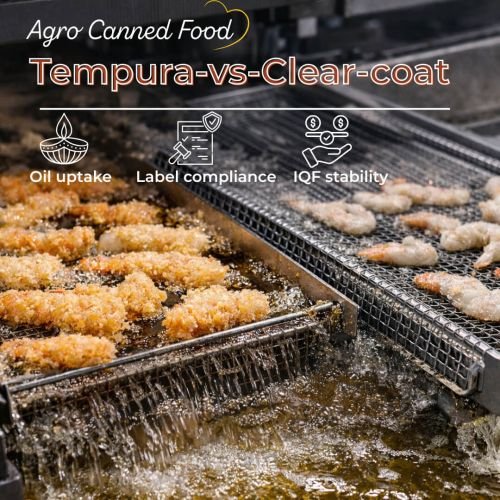
Tempura vs Clear Coat Batter: Which System Stabilizes Your Shrimp Line? Executive Perspective In...
أقرأ المزيد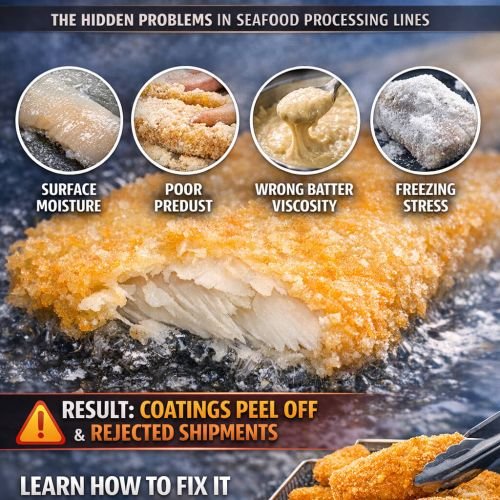
Why Fish Fillet Coatings Delaminate After Frying A Technical Guide for Seafood Processors &...
أقرأ المزيد
متخصصون في تصنيع وتركيب الهياكل الفولاذية مثل الأبراج والأعمدة والمستودعات والأعمدة والخزانات والناقلات بالإضافة إلى تركيب الألعاب المائية للمنتزهات المائية في جميع أنحاء العالم.
 English
 العربية
 Spanish
 Germain