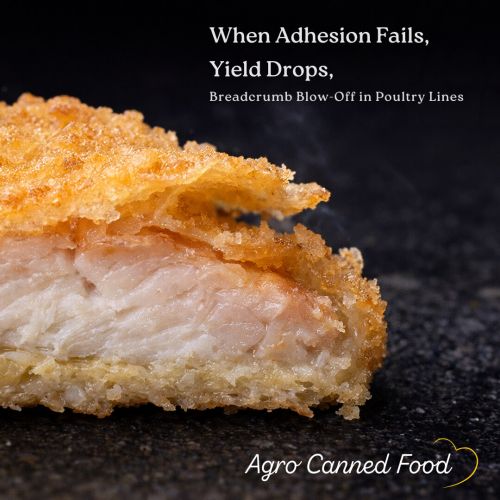
Breadcrumb blow-off in poultry processing is not a minor surface defect.
In high-volume nugget and fillet lines, even a 3–5% coating loss can:
Reduce finished yield per ton
Increase oil contamination rates
Overload filtration systems
Shift declared coating ratios outside retail tolerance
Trigger audit deviations under IFS or BRC standards
For export-oriented poultry processors, blow-off is not cosmetic.
It is operational risk.
Understanding the real causes requires analyzing the full coating system — not just the breadcrumb.
Breadcrumb blow-off refers to the partial or complete detachment of the outer crumb layer from battered poultry products during:
Frying
Post-fry transfer
Cooling
IQF freezing
Packaging or transport
It results in:
Bare spots on nuggets or fillets
Excess crumb accumulation in fryer oil
Visible surface inconsistency
Increased oil degradation
| Parameter | Typical Impact Range |
|---|---|
| Coating Loss | 2–6% depending on line stability |
| Yield Reduction | 15–40 kg per ton processed |
| Oil Contamination Increase | 8–15% higher crumb load in oil |
| Retail Tolerance Deviation | ±1–2% coating ratio risk |
| Rework Cost Increase | Significant in private label programs |
Even small instability multiplies across large-scale production.
Fresh-cut or marinated poultry retains high surface moisture.
If surface water is not controlled:
Steam forms aggressively during frying
Internal pressure lifts the crumb
Adhesion weakens before structural setting
Blow-off is frequently a steam management issue.
Predust acts as the adhesion bridge between poultry protein and batter.
Failures include:
Uneven application
Incorrect granulation
Low pickup
Poor protein-starch bonding
Without strong anchoring, crumb detaches under thermal stress.
If batter is too thin:
→ Weak film formation
→ Poor crumb embedding
If batter is too thick:
→ Moisture entrapment
→ Steam pressure beneath coating
Industrial poultry lines require viscosity monitoring per shift — not per batch.
Critical variables:
Particle size distribution
Bulk density
Oil absorption capacity
Mechanical durability
Low-density crumbs are more vulnerable to vibration loss.
Overly dense crumbs may fail to integrate properly into batter.
Compatibility between batter rheology and crumb structure is essential.
Improper thermal calibration leads to:
Rapid surface sealing
Steam expansion beneath coating
Structural lifting
Alternatively, low oil temperature increases oil absorption and weakens cohesion.
Thermal mapping of fryer zones is often the hidden corrective measure.
Blow-off frequently occurs after frying due to:
Conveyor transfers
Cooling belt vibration
IQF air turbulence
Packaging drop height
Marginal adhesion fails under mechanical load.
During blast freezing:
Poultry muscle contracts
Coating contracts at a different rate
Microfractures form
If bonding strength is insufficient, crumb detachment increases post-freeze.
Blow-off often becomes visible only after IQF validation.
In EU and export markets, poultry processors must consider:
Declared coating percentage accuracy
Fat content labeling stability
Consistency in surface coverage
Audit traceability under IFS / BRC / HACCP
Exceeding declared coating tolerance by even 1–2% can:
Trigger non-conformance
Require corrective action documentation
Risk delisting in private label programs
Blow-off is therefore a compliance variable — not just a technical defect.
To reduce breadcrumb blow-off, poultry processors must stabilize:
Coating stability must be engineered as an integrated system.
In stable industrial systems, coating loss typically remains below 2–3%.
Levels above 4–5% indicate system imbalance.
Rarely.
In most cases, the root cause lies in moisture imbalance, weak predust adhesion, or thermal miscalibration.
No.
Temperature adjustment without addressing moisture and adhesion layers may temporarily reduce symptoms but not eliminate root causes.
IQF introduces differential contraction stress between muscle and coating.
Weak adhesion becomes visible only after freezing.
Detached crumbs increase oil contamination load, accelerating oil degradation and filtration frequency.
Breadcrumb blow-off is rarely a breadcrumb defect.
It results from the interaction between:
Moisture + Adhesion Architecture + Thermal Stress + Mechanical Load + Freezing Dynamics
Industrial poultry processors must treat coating stability as a system engineering discipline.
Blow-off prevention begins before the fryer — and must be validated after freezing.

أخبار المنتجات
IQF Freezing Stress and Its Impact on Fish Coating Adhesion 2026-08-05
أخبار المنتجات
How Batter Viscosity Drift Breaks Fish Coatings | Improve Coating Performance 2026-08-05
اخبار الشركة
The Hidden Cost of Inconsistent Coating Pickup 2026-07-06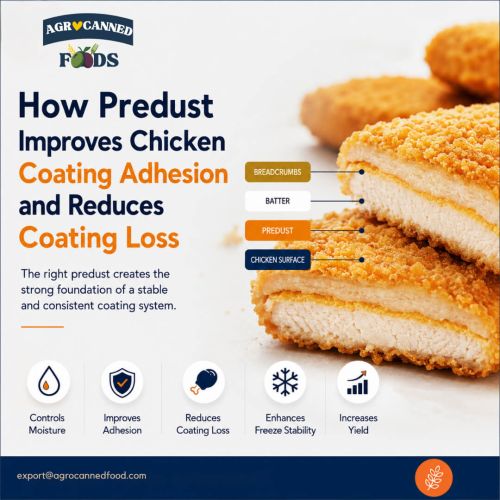
How Predust Improves Chicken Coating Adhesion and Reduces Coating Loss Strong coating adhesion is...
أقرأ المزيد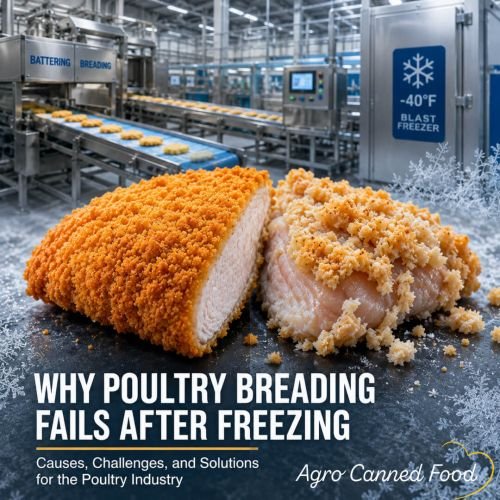
Why Poultry Coatings Fail After Freezing Understanding the Hidden Cost of Coating Failure In the...
أقرأ المزيد
For poultry processors, achieving a crispy coating is only part of the challenge. Many...
أقرأ المزيد
Color Consistency in Poultry Coatings Explained: The Critical Role of Breadcrumb Performance...
أقرأ المزيد
How Breadcrumb Particle Size Changes Chicken Texture In breaded chicken products, texture is...
أقرأ المزيد
Not a Fryer Issue: Understanding Poultry Coating Failures in Industrial Lines In poultry...
أقرأ المزيد
متخصصون في تصنيع وتركيب الهياكل الفولاذية مثل الأبراج والأعمدة والمستودعات والأعمدة والخزانات والناقلات بالإضافة إلى تركيب الألعاب المائية للمنتزهات المائية في جميع أنحاء العالم.
 English
 العربية
 Spanish
 Germain